

Padanaram Village & South Dartmouth Real Estate: A Local's Guide
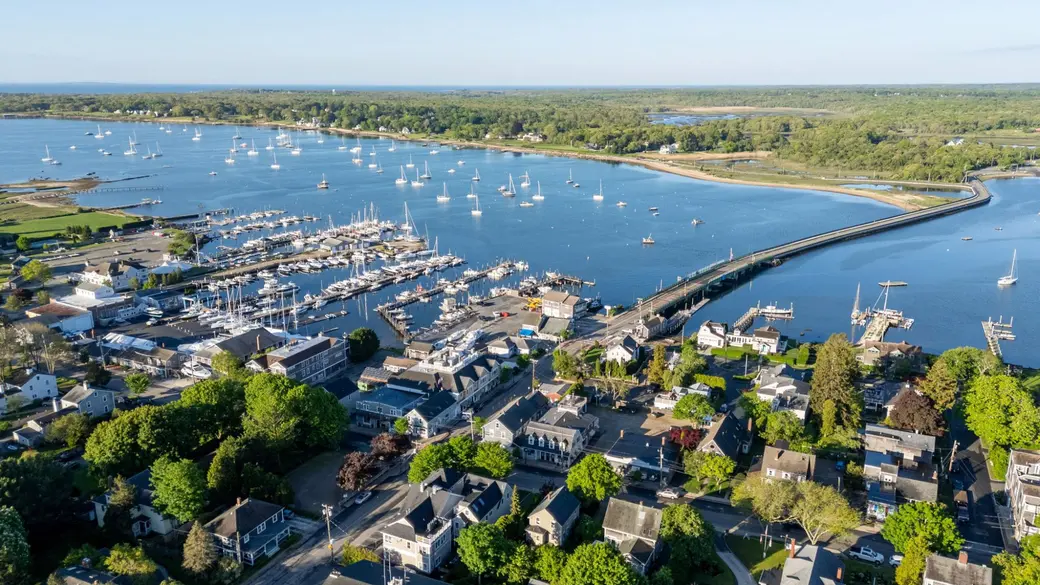
When someone says Padanaram, the picture that comes to mind is a summer afternoon walking down Bridge Street toward the harbor, the sun reflecting off the water, the steady ka-lunk, ka-lunk of cars crossing the swing bridge, kids on bikes weaving down the sidewalk, the shops on Elm Street busy with the day. That sound and that light are the village's signature. They have been for as long as anyone can remember.
This is a guide to that village. Where it is, what it is, what to do there, what it is like to live there, and the centuries of history that built it. Written from inside the place, not outside it.
Where is Padanaram?
Padanaram is a village in South Dartmouth, Massachusetts, centered on Apponagansett Bay. It is part of the larger town of Dartmouth, about ten minutes from downtown New Bedford, forty-five minutes from Providence, and just over an hour from Boston. Locally, almost no one calls it Padanaram in conversation. People call it the village.
The pronunciation is the first thing people get wrong. It is PAID-NAIR-UM, three syllables, the accent on the first. Almost everyone trips over it on the first try, including people who have lived in Massachusetts their whole lives. Locals are patient about it because they were once corrected too. The name is one of four the village has had across its history, and the others are worth knowing.
Padanaram has been on the National Register of Historic Places since September 1985. The historic district covers Federal-style houses on Fremont and Pleasant Streets, the harbor, and most of the village's commercial core.
The Four Names of Padanaram
The Wampanoag who lived on this coast for centuries before the English arrived called the place Ponagansett, sometimes anglicized as Apponegansett. That name is the bay, the river, the Friends Meeting House over in Russells Mills, and Apponagansett Park north of the bridge. It is older than any English name on the map and it is still in active use.
After the American Revolution, the village was known for about twenty years as Akin's Wharf, sometimes Akin's Landing, in honor of Elihu Akin. Akin had driven three Tory sympathizers out of the village before the war. In retaliation, on September 5 and 6, 1778, British raiding parties landed at Padanaram and burned his property, including a vessel his sons James and Elihu had on the stocks. The story goes that Akin's sister put out a fire the British soldiers set in her house three times in a row, and they gave up.
The name Padanaram first appeared in a deed signed by Laban Thatcher in 1828. Thatcher had come to the village from Harwich around 1805 and run a successful shipyard on the Apponagansett. By local tradition, he identified personally with the biblical Laban from the Book of Genesis, who lived in a place called Paddan Aram, and named his adopted village accordingly. The name stuck.
Today, locals just say "the village." That is the fourth name and the one in actual daily use.
A Working Village With Centuries of Reasons
The English settlement of Dartmouth began in 1652 when William Bradford and 33 other members of the Plymouth Colony purchased the land along the Apponagansett River from the Wampanoag leaders Wasamequin and Wamsutta. Old Dartmouth, as it was then called, was established formally in 1664 by Quakers fleeing the orthodoxy of the Massachusetts Bay Colony. The Apponegansett Friends Meeting House over in Russells Mills, built in its current form in 1791, is the oldest Quaker meeting house in southeastern Massachusetts.
The village did not escape King Philip's War. In 1675, when the Wampanoag rose under Metacomet against the colonists, the English in Padanaram took refuge in Russell's Garrison about a mile north of the village. The ruins are still visible at the foot of Lucy Street. The Wampanoag eventually surrendered to the garrison on the strength of promises from Captain Eels and Ralph Earl. Plymouth Colony then sent Captain Benjamin Church, who broke those promises and marched 160 Native captives, including King Philip's wife and son, to Plymouth, where they were sold into slavery to the Spaniards. The Wampanoag presence in Dartmouth persisted long past that war and was documented through the 19th century in the 1861 Massachusetts state report on Native peoples.
In the eighteenth and early nineteenth centuries, the village became a shipbuilding center and a minor whaling port. The ship Dartmouth, one of three vessels raided in the Boston Tea Party of 1773, was built here. Between 1845 and 1858, the yard of Mathews, Mashow & Co. built fourteen barks, one brig, nineteen schooners, and one sloop. John Mashow trained under Laban Thatcher before starting his own operation.
The salt industry rose in response to the embargoes of the War of 1812. The Ricketson family's farm at Ricketson's Point, now known as Salters Point, was the heart of it. The Howland family's Bush works on Gulf Road, just west of the village, operated from 1828 into the early 1900s, with a 680-foot bush rack and 104 rooms spread across the point.
Laban Thatcher tried to build his own salt-grinding mill on a pier of stone he raised from the harbor floor. He topped it with a giant water tank fed by four windmills powering turbine motors. The water he could pump in four days drained in four hours. The mill never worked. The abandoned building was known forever after as Laban's Folly. During the War of 1812, the tank served as a fortress where volunteer coast guards watched the harbor for British marauders.
On September 23, 1815, a hurricane swept up the Apponagansett. A large vessel anchored opposite the yacht club was lifted by the tidal wave and carried over the head of the road, where its bowsprit punctured the side of a house. That house was still standing and occupied as of 1903.
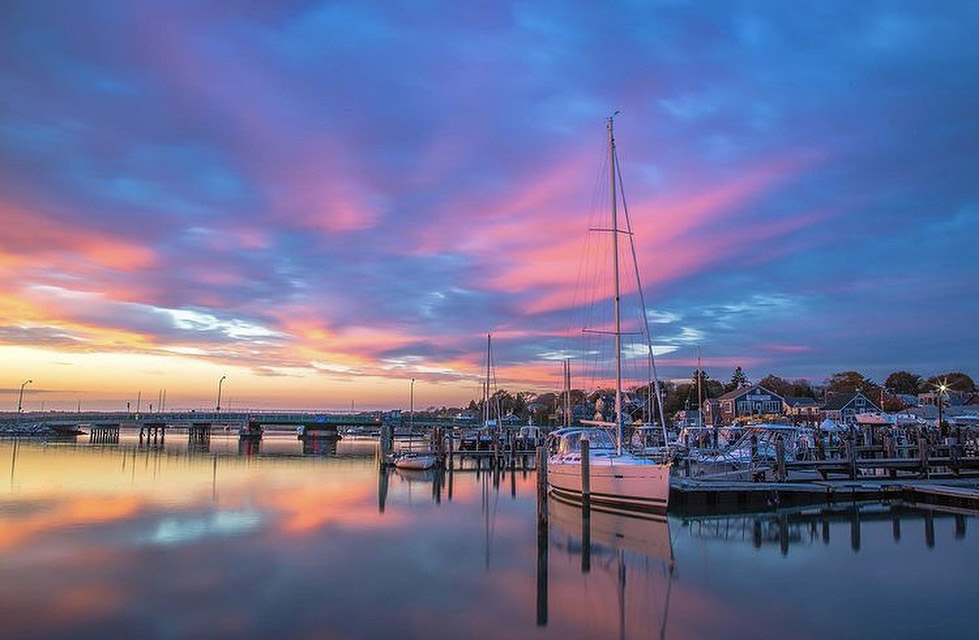
The first bridge across the Apponagansett was built between 1834 and 1836 by a corporation of Howlands, Ricketsons, Anthony, Sandford, Kirby, and Bailey. It was a toll bridge until 1870. Foot passengers paid four cents. The current swing bridge dates to 1902. Before any bridge, Charles Slocum ran a ferry across the river for four pence-halfpenny per passenger.
By 1903, the village had six stores, two tailor shops, two blacksmith shops, a hat shop, a cooper shop, a wind mill for grinding corn, and the Padanaram Academy that had operated from 1845 to 1850. The same surnames that appear in the South Dartmouth Cemetery today, the Howlands, Allens, Shermans, Ricketsons, Akins, Tripps, Giffords, and Russells, trace back to the original 1652 settlement.
A village historian named L.A. Littlefield closed his 1903 paper on Padanaram with this sentence: "We all know what the village of Padanaram is today, one of the most delightful and popular summer resorts to be found in New England. With its pure breezes coming from the bay, quiet and shady streets, and picturesque scenery, it is destined to grow in beauty and popularity as people become acquainted with its many attractions."
That sentence could be written today.
The Harbor
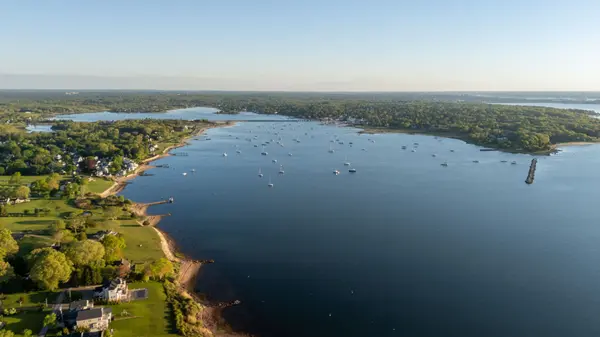
Apponagansett Bay is the heart of the village. About 600 boats fill the harbor every season, from working sailboats to summer cruisers to the occasional 100-footer that calls South Wharf home for a week.
The Padanaram Bridge is a swing bridge that connects the village to the north side of the harbor. From May through October, it opens on the half-hour from 6:00 to 8:00 a.m. and 8:00 to 9:00 p.m., and on the hour from 8:00 a.m. to 8:00 p.m. Boaters can hail the bridge tender on VHF 13 or call 508-910-7107. Closed, the bridge has eight feet of clearance at mean high water, so smaller boats can sneak under at high tide.
The view from the middle of the bridge is the village's defining picture. Sailboats moored across the bay, the line of Elm Street rooflines and old oaks behind them, Cuttyhunk on the horizon, Martha's Vineyard visible on a clear day. The bridge gets stuck sometimes on hot summer afternoons. There is nothing to do when that happens but wait, and the wait is part of the village's daily rhythm. Locals know to build it into their estimated time of arrival.
The marine ecosystem around the harbor is dense and old.
South Wharf Yacht Yard & Marina, at 218 Elm Street, has been on this site since 1832, when it was established by an Act of the Boston Congress. The yard was a working ship-building operation in the nineteenth century. The naval architect Ray Hunt designed the Concordia Yawl here, and worked out his famous Deep V hull on the same waterfront. Herman Melville came to Padanaram in the 1840s to do research that eventually became part of Moby Dick. The Concordia Company leased the wharf for 75 years. Dave Nolan bought it in 2006 and saved it from being shut down over environmental issues. Today it is a full-service yard with deep-water slips up to 150 feet, and it is also home to Cape Yachts, founded in 1986.
Davis & Tripp, at 1 Bridge Street, has been family-owned since 1947. Eighty slips, ten moorings, full mechanical and carpentry work. It is the kind of marina where the same families have been keeping their boats for two and three generations.
Concordia Company is technically at 300 Gulf Road, about a mile west of the harbor, but its history is woven into the village. Founded in 1938, the company built 103 of the legendary Concordia Yawls between 1938 and 1966, almost all of them constructed at the Abeking and Rasmussen yard in Germany. Brodie MacGregor bought the company in 1981. It still restores wooden boats and does rigging work.
The New Bedford Yacht Club is the yacht club in Padanaram, despite the name. Founded in 1877 in New Bedford, it built its Padanaram station in 1901 and made Padanaram its main location in 1941. The club hosts the Buzzards Bay Regatta every other August. The 45th edition of the Regatta is in 2026.
Marshall Marine, just north of the bridge on Shipyard Lane, is one of the village's quiet institutions. The company was founded in 1962 by Breck Marshall, who is credited by the Chesapeake Catboat Association with the rebirth of the catboat. His son Geoff Marshall runs it now. Together they have built close to 1,900 catboats, sold globally. Three models, the 15-foot Sandpiper, the 18-foot Sanderling, and the Marshall 22, plus the Sakonnet 23, a Joel White-designed daysailer whose molds Marshall acquired in 2011 from Edey & Duff of Mattapoisett. The Padanaram Rendezvous, the annual gathering of Marshall catboat owners, happens every July.
Nauti Jane's Boat Rentals operates from the docks at South Wharf and was founded in 2010. They rent kayaks, paddleboards, and Cobia powerboats. They also run a pay-as-you-go boat club with no annual contracts and no off-season fees, which is, practically speaking, the answer to one of the questions buyers ask most often: do I need to own a boat to live in Padanaram?
Padanaram Harbor has been voted the best harbor in the US year after year by USHarbors.com.
The Public Waterfront
The Dartmouth Maritime Center, at the corner of Bridge and Water Streets, opened May 24, 2019. The 530-square-foot building houses public bathrooms, showers, a welcome room, and the seasonal office of the Dartmouth Harbormaster. The 1,500-square-foot promenade and viewing deck out front is one of the best public spots in the village to sit and watch the harbor. It is open Memorial Day to Columbus Day each year. The current Harbormaster is Steve Melo. The center sits on land that, in the words of one local official, had been the town's eyesore two years before it opened.
Across the bridge on the north side, Apponagansett Park has a newly refurbished two-lane public boat ramp, a playground, a beach, and a stage that hosts Wednesday-night concerts in summer. The walk-up window at Gulf Hill Dairy Ice Cream Bucket is inside the park, with lobster rolls, burgers, frappes, and ice cream.
Directly across the street from the park, the Knowles Reserve has trails through coastal woodlands and salt marsh. Osprey, heron, and egret nest there. It is a quiet place to walk year-round.
Just upriver from the bridge, paddlers can explore the Apponagansett by kayak, canoe, or paddleboard. A quarter mile north of the drawbridge sits Little Island, known locally as Monkey Island. In summer the water around it is warm enough to swim.
Walking the Village
The village's commercial heart is a tight cluster of streets, mostly Elm and Bridge, with a few satellites on Water. You can walk it in twenty minutes. People come back and walk it again.
Start at the bridge end of Elm Street. The first stop is Dockside Ice Cream at 1 Bridge Street, the walk-up window that has been called Dockside as long as anyone in the village remembers, even through changes in ownership. Dockside is where you stop on your way home from the beach, where bikes pile up out front, where you eat your cone leaning against the railing watching the harbor. The Maritime Center stands directly across the street.
Cross Bridge Street and you are in the food cluster. Farm & Coast Market at 7 Bridge Street and Little Moss at 6 Bridge Street sit directly across from each other. They are run by the Lofberg family. Per Lofberg, who came to Dartmouth from Sweden, founded Farm & Coast in 2016 on the idea of an old-world community grocery that knows its suppliers and its customers by name. His son John and daughter-in-law Lisa, the chef-owner, run Little Moss, which opened in 2015. Farm & Coast does provisions for boaters, catering from a production kitchen at 631 Dartmouth Street in the old Friendly's building, fresh bread, prepared meals, wine, flowers, and a coffee window across the street. The two businesses support each other in small daily ways. Little Moss bakes some of Farm & Coast's baked goods. Farm & Coast points dinner guests across the street.
Farm & Coast is the business that turned the village around. Before it opened, the early 2000s version of the village was thinning out. A grocery store closed. Elaine's was a thing of the past. The Unusual Shop and the Woodhouse Shop were both ready to close. The Bridge Street Grille was ready to be torn down. Sidewalks had sinkholes. The village was not a destination, it was a pass-through. The bridge held steady through it, and so did Norton Gallery, and a few other anchors, but the commercial life was scarce. Farm & Coast brought a refined sensibility back to the village and the rest followed. What started as a market is now a multi-format operation that serves you from morning through night, including a recent coffee shop pop-up tucked behind the Dartmouth Cultural Center's art gallery.
The building that now houses Little Moss has its own continuity. Before Little Moss, it was a cafe called The Beach Plum. Before that, it was a sandwich shop called Cecily's. Cecily's was where the village kids met on early release day. A short bike ride and a few dollars got you a Snapple or a Sobe and a toasted baguette with butter. The smell of the deli counter, the curved glass case, the line of kids at the counter, all of that lived in that same room. Three generations of village kids have had their first independent food experience in the building that now serves Lisa Lofberg's dinner menu.
A block over on Water Street, The Black Bass Grille at 3 Water Street is the village's live music spot. It has been there for decades. The crowd is there for the band on a Friday night and the bar.
Heading up Bridge Street, Seagrass Studio occupies a building that dates to 1850. The structure was a barn, then a fish market, and has housed a needlepoint shop for decades. Elizabeth Crane Swartz, who took it over in July 2025, is the fifth owner of the needlepoint operation. Her own brand, Elizabeth Crane Swartz Designs, is sold there alongside the broader needlepoint inventory. Open Thursday, Friday, and Saturday.
Around the corner, Bridge St. Gallery is an artist cooperative founded by Sarah Morse twelve years ago. Around ten core artist-owners share the space with another ten on consignment. Jewelry, sculpture, glass, photography, painting, all from artists who live in the South Coast or greater New England.
The four-way intersection at Bridge and Elm is the heart of the commercial village. On one corner is Scuttlebutt Coffee at 10a Bridge Street, run by Mike and Casey along with Jake and Maya. The menu rotates almost weekly. People in the village call it the Cheers of the village, the place where everybody knows your name. The catering is some of the best food in the area.
Across from Scuttlebutt at 312 Elm Street, Strawberry Moon opened nine years ago and expanded in 2025. Andrea MacDonald started it as a handmade crystal jewelry business. Now it is crystals, candles, clothing, gifts, jewelry, tarot readings, and a community of regulars who come for the shop and stay for the conversation.
South on Elm Street, the retail spine. Knotty Knit at 302 Elm. Padanaram Outfitters at 321 Elm, owned by Natalie and George Sines, opened in 2017. The shop describes itself as Padanaram's front porch, and the description holds up. Padanaram-branded gifts you can give as a hostess present without it reading as a souvenir. Natalie also owns Dahlia Living, a separate gift shop a few doors away.
Across from Padanaram Outfitters, the Flora family of shops. Flora Home at 324 Elm, Flora Style at 368 Elm, and Flora Etc., all owned by Anne and Richard Sadow. Three storefronts, three slightly different focuses. Home goods at Flora Home, women's clothing and accessories at Flora Style, curated specialty at Flora Etc.
Norton Framing & Gallery at 330 Elm Street is the longest-standing retail business in Padanaram Village. Raymond and Judy Norton opened it in 1980. Their son Philip has run it since 2009. Custom framing plus rotating fine art from South Coast artists. Jill Law, Barbara Healy, Heather Stivison, John Irwin, Lynn Ricci, Susan Cabral, and Peggy Call-Conley are some of the regular names on the walls. Through every cycle the village has had, Norton has been there.
Details & Design at 332 Elm Street has been Margaret Silvia's for twenty years. Home decor and clothing, vintage and new together. The building was a barbershop, then a donut shop, before Margaret moved in. Margaret describes the recent arc of the village this way: it used to be a thriving village where you could get your medicine and your back-to-school tights, and now it is on the upswing. The late July sidewalk sale always includes a tent sale in her back parking lot.
Shara Porter Designs at 338 Elm sells hand-printed leather goods. Shara has an MFA in Textiles from UMass Dartmouth from 2004 and prints out of a former textile mill in New Bedford. Her shop is the storefront for a national brand distributed at retailers from Brooklyn to Asheville to Jackson, Wyoming. She has been in the village for six years.
Folia at 354 Elm, owned by Wendy Joblon, sells children's apparel, personalized gifts, and stationery. The shop is closed for renovations into early 2026.
Karyne and Company Day Spa at 368 Elm Street has been owned by Karyne Martins since 2009, in its current renovated space since November 2011. Skin care, massage, manicures, pedicures, waxing, bridal events. Dermalogica, PCA, and Pevonia product lines.
Ellaria is the newest of the village's wellness establishments, on Elm Street, opened in May 2026. Co-owned by Rachel Boyer-Mendonca and Kelley Cabral-Mosher, it is a salon and wellness collective in one space. Rachel spent 27 years at Stephen & Co Salon and now runs Ellaria's beauty services. Kelley is a licensed psychotherapist who spent thirty years doing community work in Greater New Bedford. Together they offer hair, therapy, life coaching, energy work, mindfulness, and community workshops, with a bridal collective for wedding parties to gather before ceremonies. The tagline is "Rooted in Beauty, Elevated in Spirit." Like Padanaram Outfitters and Scuttlebutt before it, Ellaria has positioned itself as a place where you can stop in just to say hi, or have a cup of coffee, without having booked anything.
Found Treasures Co. at 322 Elm, owned by Leila Texeira, is a vintage and curated home goods shop with rotating seasonal themes. Sandbar Home, opened in 2025 by Sarah and Jason Maurer, has old-school Florida flair, home decor, vintage finds, and a design bar of fabrics and wallpapers. Village Sweet Shoppe, opened in May 2024 by Kathleen Paltatroni, sells everything from penny candy to high-end truffles. The Knot Hair Studio is at 238 Elm.
The Sail Loft at 248 Elm, on the South Wharf property, is owned by ServedWell Hospitality, the company Steve Silverstein founded after starting Not Your Average Joe's. The menu is classic New England, family-friendly, with the peanut butter dessert from the Not Your Average Joe's lineage on the dessert menu. The covered outdoor area looks out at boats in the parking lot rather than the harbor itself, which is honest, and the place is consistently good.
A pattern shows up if you walk Elm Street long enough. Padanaram Outfitters calls itself the village's front porch. Scuttlebutt is described as the Cheers of the village. Ellaria invites people to stop in for a cup of coffee without an appointment. Three different businesses, each independently positioning itself as a community gathering place. That is not a coincidence. That is the village's character expressing itself through its commercial layer.
The Dartmouth Cultural Center
The Dartmouth Cultural Center at 404 Elm Street occupies one of the village's most architecturally significant buildings. Old Southworth Library, built in 1889 in the Richardsonian Romanesque style with a fieldstone exterior, was added to the State and National Register of Historic Buildings in 1987, a separate designation from the broader village historic district.
The building was a gift from John Hayward Southworth, a native of Padanaram who had moved away and built a fortune, in memory of his father Deacon John Southworth. Southworth's family roots trace back to the literal founding of Plymouth Colony. He was a descendant of Alice Carpenter, who arrived in Plymouth in 1623 to marry George Bradford, the first governor of the colony. Theirs was the fourth marriage in the Plymouth settlement.
The library opened February 1, 1890. Architect Robert H. Slack donated his services. Contractor Samuel M. Davis built it for $4,785. A library card cost fifty cents and late fees were one cent a day. In 1921, the Padanaram Improvement Association, the predecessor to today's Padanaram Business Association, donated $475 to bring plumbing and running water into the building. The library outgrew its space by 1958. A new Southworth Library opened on Dartmouth Street in 1969. Old Southworth then housed a senior center, then Dartmouth Natural Resources Trust, then sat empty from 2016.
In 2017, a community group calling itself Save Old Southworth came together to keep the building active. It became the Dartmouth Cultural Center, now under President Pauline Santos, with the building leased from the Town of Dartmouth. The Center hosts year-round rotating gallery exhibitions in partnership with South Coast Artists, plus educational programs, lectures, workshops, and an annual Holiday Arts Exhibit timed to the Padanaram Holiday Stroll. Gallery Director Jill Law oversees the programming. In 2023, the Cultural Center won a $160,000 matching grant from the Massachusetts Cultural Council, matched by Dartmouth Community Preservation Committee funds, for accessibility upgrades and HVAC. The center is open Thursday through Saturday from 11:00 a.m. to 3:00 p.m. and closes for January and February each year.
Three structures hold the village together across centuries. The yacht club has been on its current site since 1901. The South Dartmouth Cemetery has been collecting the village's founding families since before any current name was in use. And the fieldstone building at 404 Elm has been the village's civic and intellectual anchor, in one form or another, since 1889. Every shop in the village has changed hands at some point. These three have not.
The Seasonal Rhythm
Summer is the version of the village most visitors see. The harbor fills with about 600 boats. The yacht club hosts the Buzzards Bay Regatta in August every other year. Marshall Marine hosts the Padanaram Rendezvous in late July. The Padanaram Village Sidewalk Sale runs the last Saturday in July, and the Padanaram Summer Festival fills the streets the same weekend with live music and vendors. Wednesday-night concerts run at Apponagansett Park. The village is at its most visible and most full.
Fall is what most people get wrong about Padanaram. September and early October are the village's quintessential season. The summer heat has dissipated. The sailor rush has eased. The kids are back in school. The weather is mild and clear. You can still walk over the bridge with a Dockside cone on a cool evening. The village shifts from a place hosting visitors to a place that belongs to itself again. It is the perfect close to a busy summer, and locals will tell you it is the best time of year to be here.
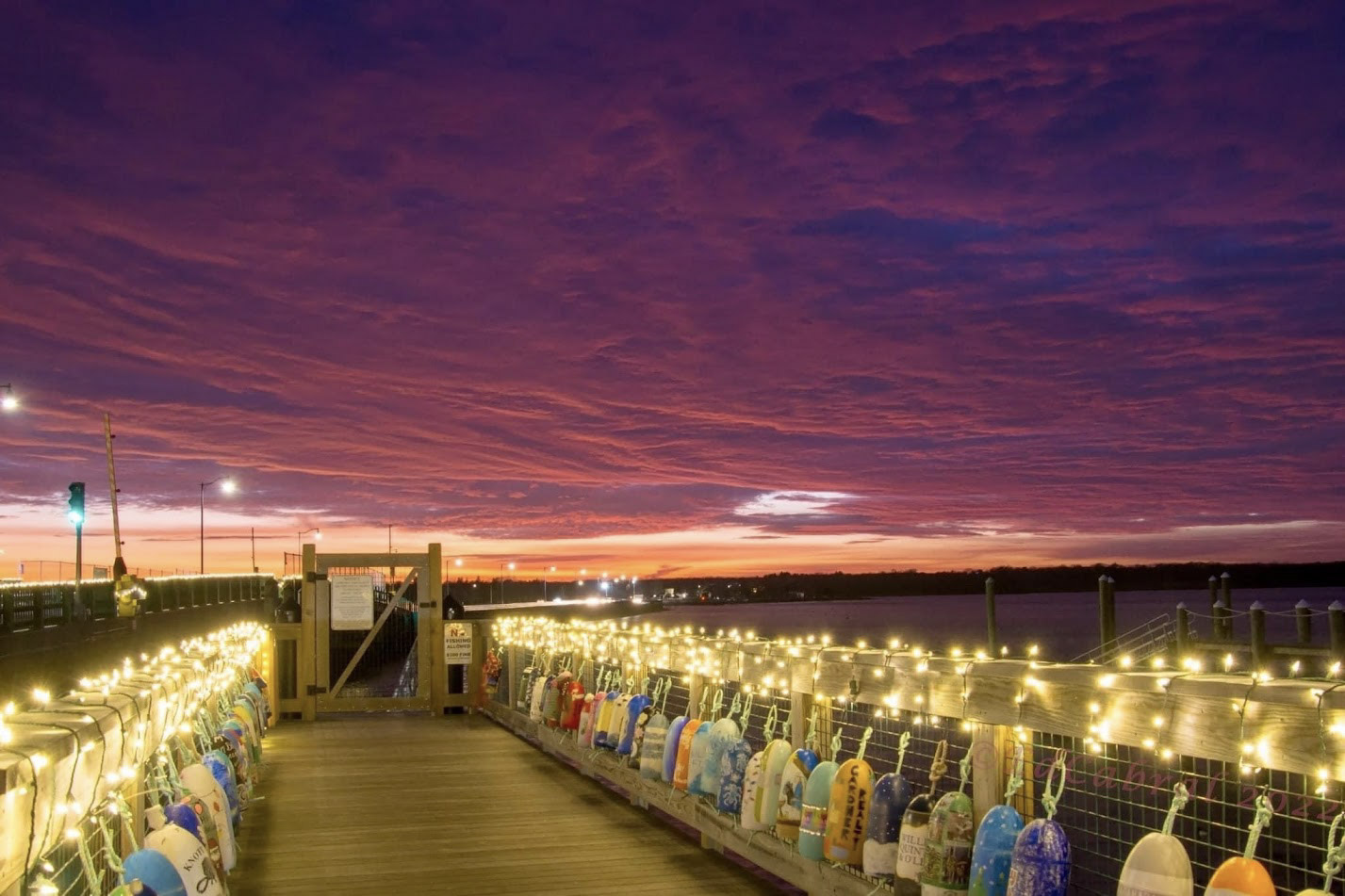
Winter is quieter, with most retail closing for January and February and a few exceptions staying open. The holiday season holds three of the village's anchor events. The Padanaram Sip and Stroll on the Sunday before Thanksgiving kicks the season off with roughly half a million Christmas lights coming on at once, elves walking the village, a cellist on a corner, Santa and Mrs. Claus, and carolers. The Padanaram Holiday Stroll follows on the first Friday of December as the major event of the season, organized by the Padanaram Business Association under current president Linda Hopps. More than twenty businesses participate.
The Buoy Tree is the village's newest holiday tradition. It was started in 2021 by Molly Armando, now the founder of TIDES Real Estate Group, as a way to bring the village together at the tail end of the pandemic. The original structure was built and the supplies donated by Jenn Santo, Doug Amaral, and their family. Each year, hundreds of buoys are painted by local kids, families, Dartmouth High art students, and seniors from the Council on Aging. Fifty are selected for an online auction that benefits a different local charity each year. The tree is lit at the Maritime Center during the Holiday Stroll and stays up through early January. It is the new heart of the village in winter, a tradition built fresh in a moment when the village needed one. Most traditions feel like they have been around forever. This one is new, and that is part of what makes it work.
Spring is the village waking up. Boats go back in the water. The shops that closed in January reopen by March. Farm & Coast starts scaling its summer operation back up. The light changes, the wind comes off the harbor differently, and the village comes out of hibernation slowly, then all at once.
What It Is Like to Live in Padanaram
The structural appeal is walkability. A coastal village where you can walk out your door, get coffee, walk to the water, and be near your boat, all without a car, is rare on the New England coast. That is the actual reason people pay what they pay to live here.
Home values have moved substantially in the village in recent years. The buyer pool has expanded from its long-standing summer base in the nearby private communities of Nonquitt and Salters Point to include year-round buyers from Boston, Providence, and the Cape. The market has tightened. For current numbers, the Padanaram market report covers the details.
The social fabric is real and worth understanding before you move here. In the village, you tend to recognize people even when you do not know their names. Some buyers love that. Some find it claustrophobic. It is not a place to be anonymous in.
The honest pitch a Padanaram resident gives a Boston or Providence buyer goes something like this. The village gives you the chance to set roots and grow into a community that will grow on you. The necessities you need are minutes away in North Dartmouth or New Bedford, or a quick hop on the highway. But when you want to step away, you can cruise the stone-wall-lined back roads of Smith Neck, Potomska, and Little River. You can reach some of the best beaches in Massachusetts and walk nature trails the rest of the year. You can do all of this without the commercialization of a Hyannis and with a fraction of the traffic. A run along the bridge and down Smith Neck, with the view across the harbor as old homes and boatyards rise from the water and the old oaks splash green above the rooflines and an occasional mast and sail break the horizon, is hard to describe and impossible to forget once you have lived with it.
There are honest trade-offs. Parking is a real issue, particularly on summer Saturdays. The Padanaram Business Association has been working with the town on solutions. The bridge is state-run and gets stuck on hot days. The causeway was rebuilt over a multi-year stretch during which the village was largely inaccessible from the south side. None of this is a deal-breaker, but a buyer should know it going in.
The village is not for everyone. If you want city life, endless noise, a wide range of diverse food options, or easy access to big-time sporting events, performances, or concerts, the village is not going to fill that itch. New Bedford is twelve minutes away and Providence is forty-five, but the village itself is not a city. It is a village. That is the point.
There is one piece of local vocabulary worth knowing. A Pundy is the village's word for a quintessential Padanaram resident. For some people, the term carries a real edge. For others, it is fully embraced and worn lightly. The classic look from Lisa Birnbach's True Prep would catalog the Pundy archetype as Nantucket-red pants, Sperry top-siders, a nautical belt, and a casual polo. The more relaxed version is flip-flops, board shorts, an optional shirt, and a faded hat. Both versions are visible on Elm Street on any given summer Saturday, worn by people whose connection to the village ranges from six generations to six months.
How Padanaram Fits Inside Dartmouth
There is no clear line where Padanaram begins and ends. That is a feature, not a problem.
Technically, Padanaram is a village within the larger area of South Dartmouth, which is one part of the town of Dartmouth, Massachusetts. South Dartmouth has many of its own subsections, including Salters Point, Mishaum Point, Smith Neck, Gulf Road, and Russells Mills, among others. North Dartmouth and the central part of the town are different again, with their own characters.
But ask anyone who lives there where Padanaram actually starts and ends, and you will not get a clean answer. Some people draw the line at the bridge. Some at Salters Point. Some at Elm Street and a few blocks in either direction. Some people will tell you Padanaram is wherever you can walk to the village from in a reasonable amount of time. The boundary is soft on purpose, and locals like it that way.
What people agree on is the center: the harbor, Elm Street, the bridge. From there, the village radiates out into the rest of South Dartmouth without a fence. A house on Smith Neck Road might be considered Padanaram-adjacent. A house on Gulf Road might be considered part of the village for some purposes and not for others. A summer renter in Nonquitt might say they are staying in Padanaram even though Nonquitt is its own thing entirely.
This matters for buyers. The village does not have a town line to defend, so people are not territorial about who counts as part of it. The village absorbs its neighbors, and the neighbors lean on the village. That is part of why the place works.
What You Discover After You Move Here
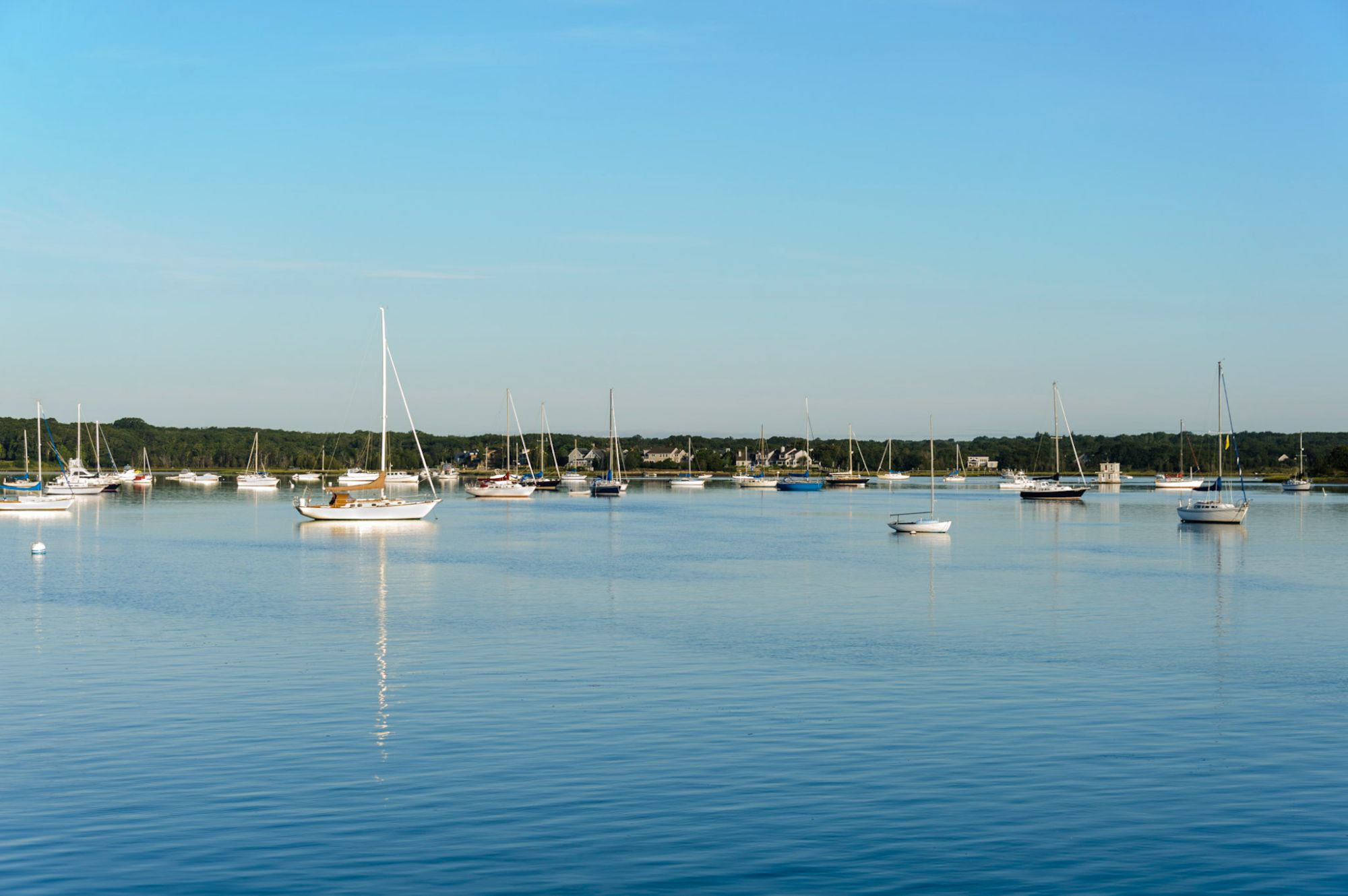
The thing buyers learn after they have moved to Padanaram, that no guide can quite prepare them for, is the desire to always be close to the water. The village brings the water into daily life in a way that becomes structural to how you live. There's truly no other place in the world like it. We may be biased, but there's no better place in the world than the South coast of Massachusetts & Rhode Island.
Frequently Asked Questions About Padanaram
Is Padanaram a town?
No. Padanaram is a village within South Dartmouth, which is part of the town of Dartmouth, Massachusetts. It functions like its own place but is not separately incorporated.
Where is Padanaram, Massachusetts?
Padanaram is located in South Dartmouth, Massachusetts, on Apponagansett Bay. It is about ten minutes from downtown New Bedford, forty-five minutes from Providence, and just over an hour from Boston.
How do you pronounce Padanaram?
PAID-NAIR-UM. Three syllables, accent on the first. Visitors trip over it on the first try almost without exception, and locals are patient about it.
What is there to do in Padanaram Village?
The village has a working harbor, a swing bridge, restaurants, shops, art galleries, the Dartmouth Cultural Center, the Dartmouth Maritime Center, public beach access at Apponagansett Park, walking trails at Knowles Reserve, kayak and powerboat rentals at Nauti Jane's, a yacht club, and an active seasonal calendar including the Buzzards Bay Regatta, the Padanaram Holiday Stroll, the Sip and Stroll, the Sidewalk Sale, the Summer Festival, and the Buoy Tree.
What is the difference between Padanaram and South Dartmouth?
South Dartmouth is the larger area; Padanaram is one of several villages within it. The line between them is intentionally soft.
When does the Padanaram Bridge open?
From May through October, the bridge opens on the half-hour from 6:00 to 8:00 a.m. and 8:00 to 9:00 p.m., and on the hour from 8:00 a.m. to 8:00 p.m. Boaters can hail the bridge tender on VHF 13 or call 508-910-7107.
Is Padanaram a good place to live year-round?
For people who want a small, walkable coastal village with a real community, yes. For people who want city amenities, no. The village is quieter in winter, with some retail closed in January and February, and active the rest of the year.
What is the Padanaram Buoy Tree?
A community holiday tradition at the Dartmouth Maritime Center. Started in 2021 by Molly Armando as a way to bring the village together at the tail end of the pandemic. Each year, locals paint hundreds of buoys, fifty of which are selected for an online auction benefiting a different local charity. The tree is lit during the Padanaram Holiday Stroll in early December.
Where can you rent a boat in Padanaram?
Nauti Jane's Boat Rentals, operating from the docks at South Wharf, rents kayaks, paddleboards, and powerboats. They also run a pay-as-you-go boat club with no annual contracts.
What is the Dartmouth Cultural Center?
A nonprofit arts and educational center inhabiting Old Southworth Library, an 1889 Richardsonian Romanesque fieldstone building on the National Register of Historic Buildings. It hosts rotating gallery exhibitions, workshops, lectures, and an annual Holiday Arts Exhibit. Open Thursday through Saturday, closed January and February.
Categories
- All Blogs (57)
- Beaches (5)
- buyers (1)
- Buying (1)
- coastal living (17)
- Dartmouth (20)
- Dartmouth MA Real Estate (8)
- Divorce & selling a home (1)
- Equestrian (1)
- Equestrian Real Estate (1)
- Fall River, Massachusetts (1)
- Farm Coast (1)
- Farmland (1)
- Fixer Upper (1)
- Investors (1)
- Land Sale (1)
- Local Events (3)
- Local Guides (6)
- Local History (3)
- Local Real Estate News (7)
- Moving to Massachusetts (12)
- New Bedford, Massachusetts (13)
- Padanaram Village (7)
- Rental (1)
- Rochester MA Real Estate (1)
- sellers (2)
- Selling a home in Massachusetts (6)
- Selling a home in Rhode Island (1)
- South Coast Living (25)
- South Coast Massachusetts Real Estate (3)
- South Dartmouth (1)
- Southcoast, Massachusetts (16)
- The South Coast Sloop (1)
- Things to Do in Dartmouth (3)
- Things to do in New Bedford (2)
Recent Posts





GET IN TOUCH WITH US!

Broker | License ID: 9585698
REVIEWS

Ryan Lombard


C. David

Heather DaSilva
Sold our house fast in New Bedford without any repairs
MORE FROM OUR BLOG
Living in South Dartmouth & Padanaram Village
Most people have never heard of Padanaram Village, and honestly, that's part of what makes it so special. Why we kept coming back to South Dartmouth I was born and raised in Dartmouth, and surprisingly, my husband John was too. We met in first grade at Cushman School and spent our entire childhoods
Where to Look for Homes in Dartmouth, MA
If you have started looking for a home in Dartmouth, you have probably already opened three or four real estate sites and noticed something. A lot of the same houses keep showing up. That is not a coincidence, and once you understand why, it changes how you decide where to actually spend your time.
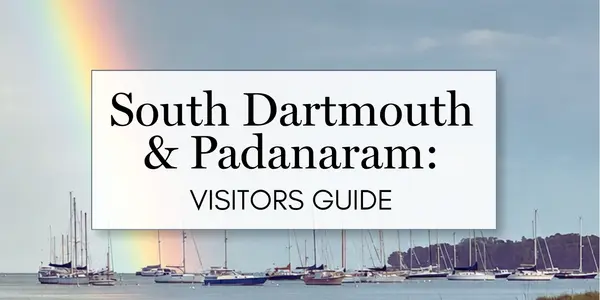
Padanaram Harbor Just Reminded Us Why It Keeps Winning
A full double rainbow set down over Padanaram Harbor last night. It came in right after a passing shower, the kind we get a lot of in late May, and it arced clean across the water from the marina side all the way over toward the bridge. Both bands showed. If you have spent any real time in Padanara